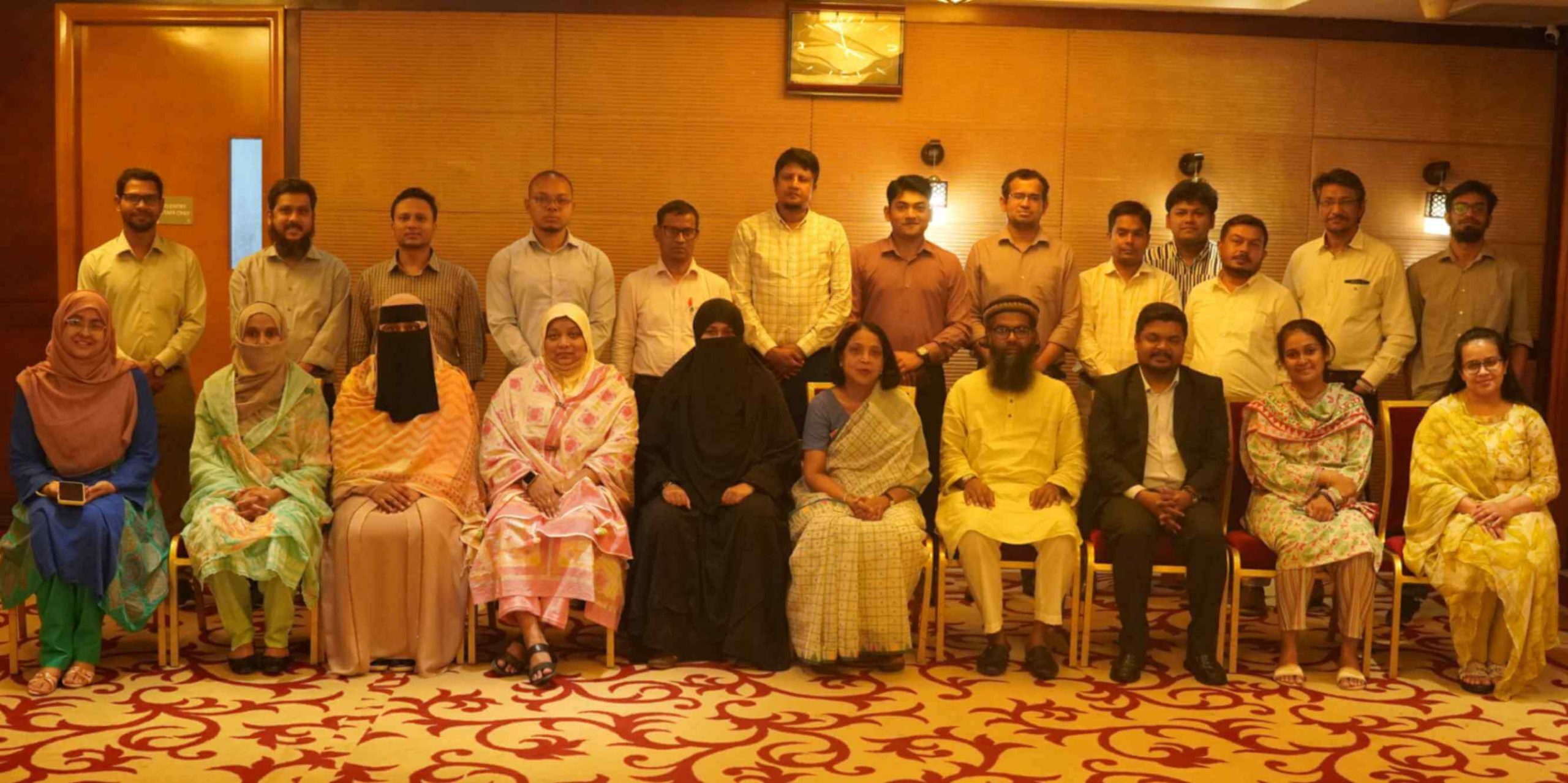

A learning session convened 18 participants from different institutions of Pakistan including the Public Health Engineering Department (PHED), Integrated Regional Support Program (IRSP), National University of Sciences and Technology (NUST), development sector representatives, academia, and UNICEF to discuss pathways for advancing safely managed sanitation in Khyber Pakhtunkhwa (KP) Province. The session was conducted by ITN-BUET on March 3, 2026.
ITN-BUET began the session by orienting participants on Bangladesh’s journey in Fecal Sludge Management (FSM) under the Citywide Inclusive Sanitation (CWIS) framework. Drawing on its experience as a regional Capacity Building Hub, ITN-BUET shared lessons from supporting six cities in Bangladesh and two in Nepal as CWIS Mentor Cities, where it facilitates CWIS action planning, institutional strengthening, and evidence-based decision-making. The session also highlighted key policy and operational reforms, including adoption of the Integrated Municipal Information System (IMIS), sanitation taxes, sanitation worker cooperatives, and use of shit flow diagrams, alongside various government initiatives on FSM.
Following the technical session, an extensive question-and-answer session took place, during which Pakistani counterparts sought clarification on institutional, financial, and operational aspects of FSM implementation. ITN-BUET explained two operational models for FSM service delivery: cooperatives formed by organized traditional workers, and private entrepreneurs operating under public-private partnership (PPP) arrangements by leasing municipal vacuum tankers. It was clarified that while operations and maintenance are often managed at the municipal level or by private operators, capital investments are largely financed by the central government, with limited financial contribution from local governments and private actors.
The discussion also explored revenue generation and cost-recovery mechanisms, including user fees and service charges, alongside practical reuse pathways for treated sludge such as co-composting with organic waste and use as alternative fuel. Participants also examined regulatory challenges, particularly meeting effluent discharge standards amid high COD and BOD concentrations in treatment outputs.
The dialogue concluded with prospects for collaboration through the Global Sanitation Graduate School (GSGS) network, with NUST exploring certified FSM and CWIS training for PHED KP engineers, as well as follow-up discussions and a study visit to Bangladesh. Through technical exchange and joint capacity building, ITN-BUET, IRSP and FANSA-Pakistan aim to strengthen climate-resilient sanitation systems in South Asia in line with SDG 6.